
Company news
Why the Curved Shell Matters: Rain, Snow and Wind Behaviour
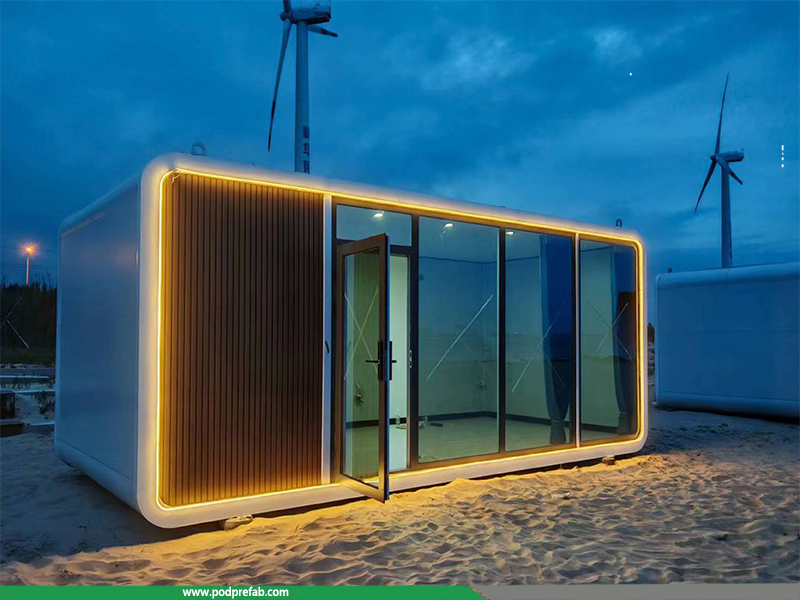
The curved shell is usually described as styling. Physically, it is a drainage and wind strategy. Three properties follow from the geometry, and all three show up in how the unit performs over years rather than days.
First, rain and snow shed naturally. A curved roof has no flat plane where water can stand. That matters because standing water is the mechanism behind most premature roof failure in flat-roofed metal structures: pooled water finds pinholes and seams, and corrosion starts from the inside of the seam where it cannot be seen. Snow behaves similarly.
On a flat roof, snow accumulates until the load becomes a structural question. On a curved surface, snow tends to slide as it accumulates once it exceeds the friction holding it in place, so the peak load is lower. Neither effect eliminates the need to design for a snow load, but both reduce how much load actually sits on the structure for how long.
Second, the shell changes aerodynamic behaviour. Wind does not load a flat wall the way it loads a curved surface. The continuous curve gives wind fewer sharp edges to catch and creates a smoother pressure distribution across the envelope, which reduces the local suction peaks that tend to pull fixings and cladding panels away.
Combined with proper anchoring, this is why curved units are often specified in exposed locations.
Third, glazing needs to be understood as part of the envelope. The full-height glass front is the signature feature, but it is also the weakest thermal and structural element if it is poorly specified. The relevant detail is the glass build-up and how it is framed, not just its size.
Units designed for demanding conditions typically use laminated or tempered multi-pane assemblies with thermal breaks in the frame, because a large single pane without a thermal break becomes a cold surface in winter and a heat source in summer.
What the published performance claims actually mean. Typical ratings for this construction state resistance to about 100 mph winds when anchored to a concrete pier foundation, with this level described as meeting International Building Code standards in many coastal areas. Two qualifiers matter. The rating is conditional on the foundation and anchoring system, not on the shell alone.
And the phrase "many coastal areas" is doing real work: coastal exposure requirements escalate close to open water, so a unit rated for a general coastal zone may still need an upgraded specification for an oceanfront site. Always confirm the site-specific requirement rather than assuming the headline rating applies.
Thermal cycling is the slower mechanism. In desert and high-altitude locations, the daily swing between hot afternoons and near-freezing nights is what ages an envelope. Aluminium expands and contracts repeatedly, and every joint, seal and fixing point is worked by that cycle.
Curved one-piece cladding reduces the number of joints compared with panelised flat walls, which reduces the number of places where movement has to be accommodated. This is why material choice and joint design show up in long-term maintenance cost rather than in a specification sheet.
What to verify before specifying. Four items. The anchoring design and who certified it, since anchoring failure is the dominant cause of wind damage to light structures. The glass build-up, including frame thermal break and safety classification. The snow load the roof is designed for, in the units used by your local authority.
And the number and treatment of joints in the cladding, because joint count predicts maintenance frequency more reliably than surface finish does.
CATEGORIES
LATEST NEWS
CONTACT US
Name: Mr. Zhang
Mobile:8613222235952
Tel:8613167199094
Whatsapp:8617315222516,8613167199094
Email:skyzhang@podprefab.com
Add:Room B1701, Building 4, Dongfang Xintiandi, Yangshe Town, Zhangjiagang, Suzhou City, Jiangsu Province, China