
Company news
Shell Materials Explained: Aluminium, Fluorocarbon Coating and Low-E Glazing
Specification sheets list materials. They rarely explain why each one was chosen. Understanding the reason makes it much easier to judge whether a particular product is appropriately specified for your site.
The skin: aluminium rather than steel. Exterior panels are typically aviation-grade aluminium, mechanically fixed to a galvanised steel chassis rather than welded to it. Two reasons drive the choice. Aluminium does not rust the way carbon steel does, so the facade does not depend on a coating to survive.
And mechanically fixed panels can be replaced individually, whereas a welded steel skin that has corroded through is a structural repair, not a maintenance item.
Panel thickness and construction. A frequently quoted specification is 2.5 mm aluminium single panel with a metal fluorocarbon baked finish. Thickness matters because the skin is not purely decorative: on a curved surface, the panel contributes to stiffness and to keeping the profile fair as the unit is lifted and moved.
Thin-gauge curved cladding distorts visibly over repeated transport cycles.
The coating: fluorocarbon, and what it is for. Fluorocarbon coatings are specified for three properties stated plainly in most technical literature: resistance to pollution, ease of cleaning, and long service life.
The practical meaning is that the finish holds its colour and gloss through ultraviolet exposure and airborne contamination, and that cleaning restores appearance rather than revealing degradation. This is the difference between a facade that can be washed and one that needs repainting.
On projects where access for repainting is difficult, the coating specification matters more than the base colour choice.
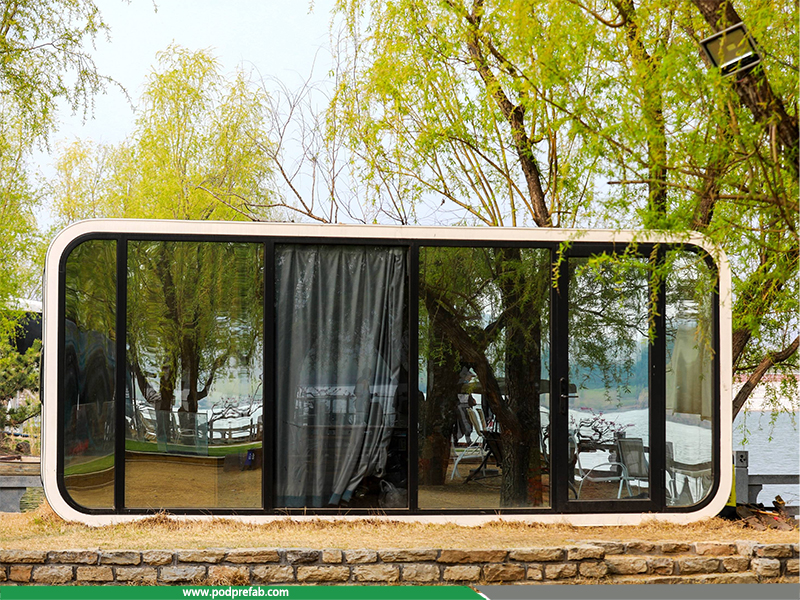
The glazing: 6+12+6 Low-E tempered. The front elevation is a double-layer tempered Low-E glass curtain wall in a 6+12+6 configuration: two 6 mm glass panes separated by a 12 mm cavity. Three functions are being addressed at once. Tempering provides the safety and strength properties required of a full-height glass wall.
The Low-E coating reduces heat transfer through the glass by reflecting long-wave radiation, which is what keeps a large glazed area from turning the interior into a greenhouse in summer. And the cavity, normally filled with an inert gas such as argon, provides the thermal break that a single pane cannot. Published properties for this build-up include ultraviolet resistance and enhanced privacy.
Material properties that are stated but worth understanding. Technical documentation for these units commonly cites flame retardance, wear resistance and oxidation resistance.
Read together, they describe a facade intended for unsupervised outdoor exposure rather than a protected interior application: it should not sustain flame, should not abrade through normal handling and cleaning, and should not oxidise in the way untreated ferrous metals do.
Where the material logic has limits. Two honest caveats. First, no coating is permanent, and fluorocarbon finishes extend the interval between maintenance cycles rather than eliminating maintenance. Second, aluminium's advantage over steel is corrosion resistance, not stiffness; where very high wind or snow loads apply, the governing factor is the frame and the anchoring system, not the skin.
A premium facade on an under-specified frame is still an under-specified unit.
How to read a facade specification. Ask for the panel thickness and fixing method, the specific coating type and its expected service interval, the exact glazing build-up including whether the cavity is gas-filled, and the frame thermal-break detail. If a specification gives a material name without a thickness or a build-up, it is describing an appearance rather than a performance.
CATEGORIES
LATEST NEWS
CONTACT US
Name: Mr. Zhang
Mobile:8613222235952
Tel:8613167199094
Whatsapp:8617315222516,8613167199094
Email:skyzhang@podprefab.com
Add:Room B1701, Building 4, Dongfang Xintiandi, Yangshe Town, Zhangjiagang, Suzhou City, Jiangsu Province, China