
Company news
Solar Site Offices: Cutting Diesel on Remote Job Sites
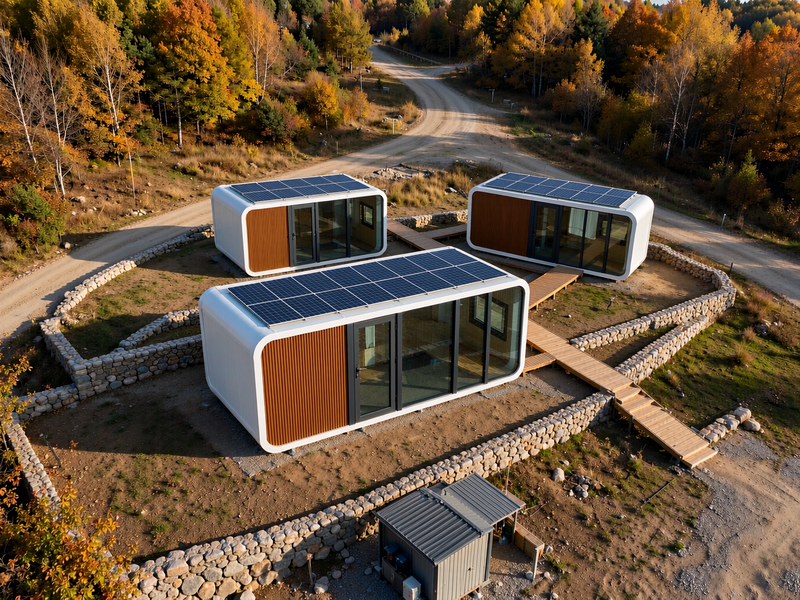
On a remote job site, electricity usually arrives as a diesel generator and a fuel delivery schedule. Both cost more than the spreadsheet suggests: fuel logistics to a mountain site, idling generators running all night for a fridge and a few lights, noise complaints from the nearest residents, and exhaust in the site office where people actually work.
What a solar site office replaces
A solar-equipped prefab unit covers
lighting, computers, a small fridge, a kettle and mobile charging directly from
PV and storage. High-load equipment — welding sets, compressors, hoists — stays
on the generator. In practice this means the generator runs only when heavy
work happens, instead of around the clock.
Where the economics land
Fuel and logistics. The largest saving, and the one that grows with site remoteness.
Generator hours. Fewer running hours means longer service intervals and fewer breakdowns on site.
Relocation value. The same unit moves to the next site; the PV package moves with it.
Compliance. Lower emissions and noise help on urban-fringe sites where permits are conditional.
Specify for the site, not for the catalogue
Site offices are working buildings:
heavy doors, boots, dust, and a shift change every twelve hours. Specify a
durable floor finish, a lockable technical compartment, and an array sized for
the worst month rather than the annual average. And insist on a generator
changeover that a site electrician can operate without a manual.
RELATED NEWS
- How to Plan an Expandable Container House Project
- Power Supply Solution for Construction Sites at High-Altitude & Cold Regions
- Apple Cabins offer multiple environmental advantages
- Do Stylish Container Houses Need Building Permits?
- The Future of Prefab Housing: From Mobile Homes to Permanent Modular Living
CATEGORIES
LATEST NEWS
CONTACT US
Name: Mr. Zhang
Mobile:8613222235952
Tel:8613167199094
Whatsapp:8617315222516,8613167199094
Email:skyzhang@podprefab.com
Add:Room B1701, Building 4, Dongfang Xintiandi, Yangshe Town, Zhangjiagang, Suzhou City, Jiangsu Province, China