
Company news
Capsule Insulation Explained: PU Foam and R-25 Without Losing Space
Insulation is the single specification that most affects running cost and guest comfort. It is also the one most often summarised with a single number, which hides more than it reveals.
The construction approach. In a purpose-built capsule unit, high-density polyurethane foam is injected directly between the exterior shell and the interior composite walls. There is no separate internal timber frame carrying the insulation. The cavity is part of the wall build-up by design, which means the insulation occupies space that was never intended to be living area in the first place.
Published performance for this construction commonly lands at R-25 or higher.
Why the build-up matters as much as the number. The comparison with a converted container is the clearest way to see it. In a container, insulation is added inside the room, so every millimetre of insulation is a millimetre of floor area lost. At small scales, that trade is not marginal: a room losing 150 to 200 mm on every external wall can lose a meaningful share of usable width.
In an injected-cavity build-up, the same insulation value is achieved without that penalty. This is the structural reason small-format units can feel more spacious than their footprint suggests.
Thermal bridging is the part a single R-value does not describe. Insulation value describes heat flow through the insulated area. Thermal bridging describes heat flow around it, through the frame, the fixings and any element that crosses the insulated layer without being broken.
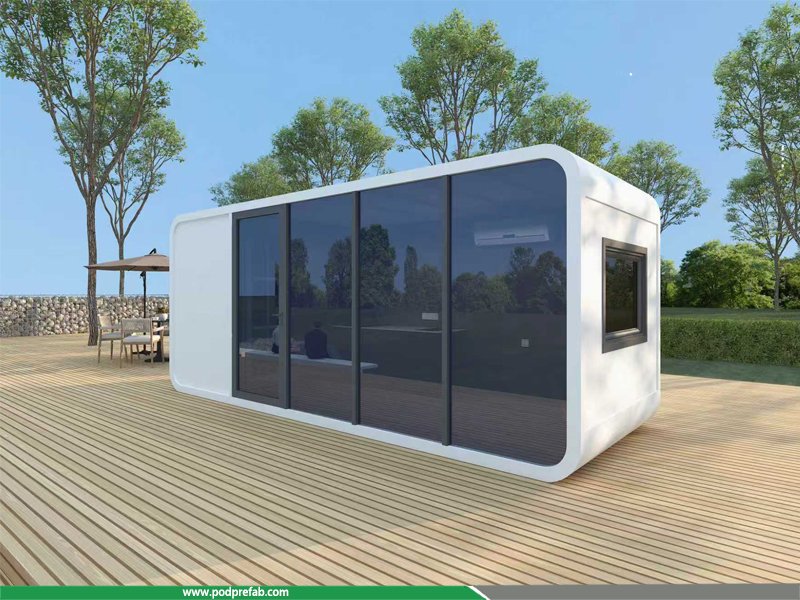
A metal-framed unit has more bridging paths than a timber-framed one, which is why the design response is to limit thermal bridging deliberately: an aluminium shell over an insulated core, a glazing frame with a thermal break, and attention to where structure penetrates the envelope.
If a specification gives an R-value but says nothing about bridging detail, the real performance will be below the number.
Glazing is usually the weakest plane. A full-height glass front can dominate the envelope. Low-E coatings reduce heat transfer through the glass by reflecting long-wave radiation, and an argon-filled cavity provides a thermal break between panes. Together these prevent the glazed area from behaving as a greenhouse in summer or a cold surface in winter.
But glass still insulates less well than an insulated wall of equivalent area, so on a heavily glazed wall the heating and cooling load concentrates there. That is where a heat pump's capacity and the shading strategy matter most.
What the number means in hot and cold climates. Insulation is not only a winter concern. In hot climates the same construction reduces heat gain, which lowers cooling load. In cold climates it reduces heat loss and, just as importantly, keeps interior surface temperatures above dew point, which is what prevents condensation forming on walls and around glazing frames.
High performance in both directions is what makes a four-season rating meaningful rather than aspirational.
Four things to verify. First, the injected foam density, since low-density foam delivers less insulation per millimetre and can settle. Second, whether the stated R-value applies to walls, roof and floor, or only to walls. Third, the glazing build-up including cavity gas fill and frame thermal break.
Fourth, the ventilation arrangement, because a tightly insulated and well-sealed unit needs controlled air exchange to manage humidity, especially where occupants cook or shower inside.
RELATED NEWS
- What Australia’s Modular Housing Market Means for Prefab Home Exporters
- Power Supply Solution for Construction Sites at High-Altitude & Cold Regions
- The Future of Prefab Housing: From Mobile Homes to Permanent Modular Living
- Arrival to Occupancy, Arrival to Power
- What Is Typically Inside an Apple Cabin?
CATEGORIES
LATEST NEWS
CONTACT US
Name: Mr. Zhang
Mobile:8613222235952
Tel:8613167199094
Whatsapp:8617315222516,8613167199094
Email:skyzhang@podprefab.com
Add:Room B1701, Building 4, Dongfang Xintiandi, Yangshe Town, Zhangjiagang, Suzhou City, Jiangsu Province, China