
Company news
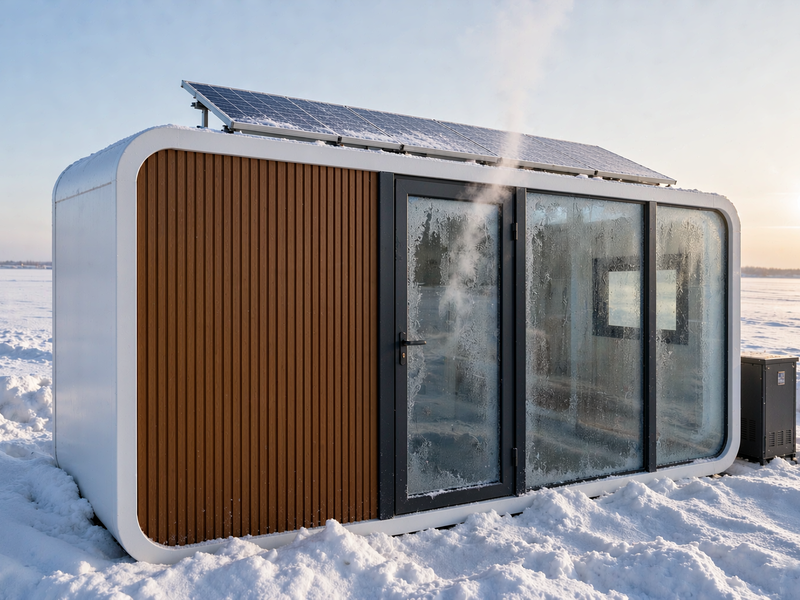
Solar in the Snow: Winter Performance of an Apple Cabin
Winter is where optimistic solar
estimates meet reality. Days are short, the sun sits low, snow settles on the
array, and the cabin simultaneously asks for its largest heating load of the
year. None of these are reasons to avoid PV in cold regions — but they change
how the system should be sized.
Yield is lower, and that is predictable
Cold actually helps a module generate —
efficiency rises as cell temperature falls. The losses come from the other
direction: shorter daylight, a lower solar angle, and snow cover. In practice a
winter month can produce roughly half the daily energy of a clear summer month
at the same site. The fix is not a bigger array alone; it is a bigger array
plus a battery sized for two or three low-yield days.
Snow load is a structural question, not a solar one
Roof snow load must be checked against local code before the array is added. Flat roofs hold snow; a mounted array with a gap underneath can trap it. Two practical measures help: leave a small clearance at the array edge so meltwater can drain, and specify a mounting angle that encourages sliding where local code permits. Snow should be cleared with a soft brush, never a metal tool.
Condensation is the quiet risk
In a heated cabin at −15°C outside, the
weak point is rarely the wall — it is the junction between the glass facade,
the frame and the interior finish. A heat-recovery ventilator keeps interior
humidity low and cuts the heating load at the same time, which matters more for
year-round liveability than one extra panel.
Cold-climate solar is a solved problem,
but only when load, storage, structure and ventilation are designed together.
Sized that way, a solar Apple Cabin stays habitable through a Hokkaido February
without a generator running every night.
CATEGORIES
LATEST NEWS
CONTACT US
Name: Mr. Zhang
Mobile:8613222235952
Tel:8613167199094
Whatsapp:8617315222516,8613167199094
Email:skyzhang@podprefab.com
Add:Room B1701, Building 4, Dongfang Xintiandi, Yangshe Town, Zhangjiagang, Suzhou City, Jiangsu Province, China